
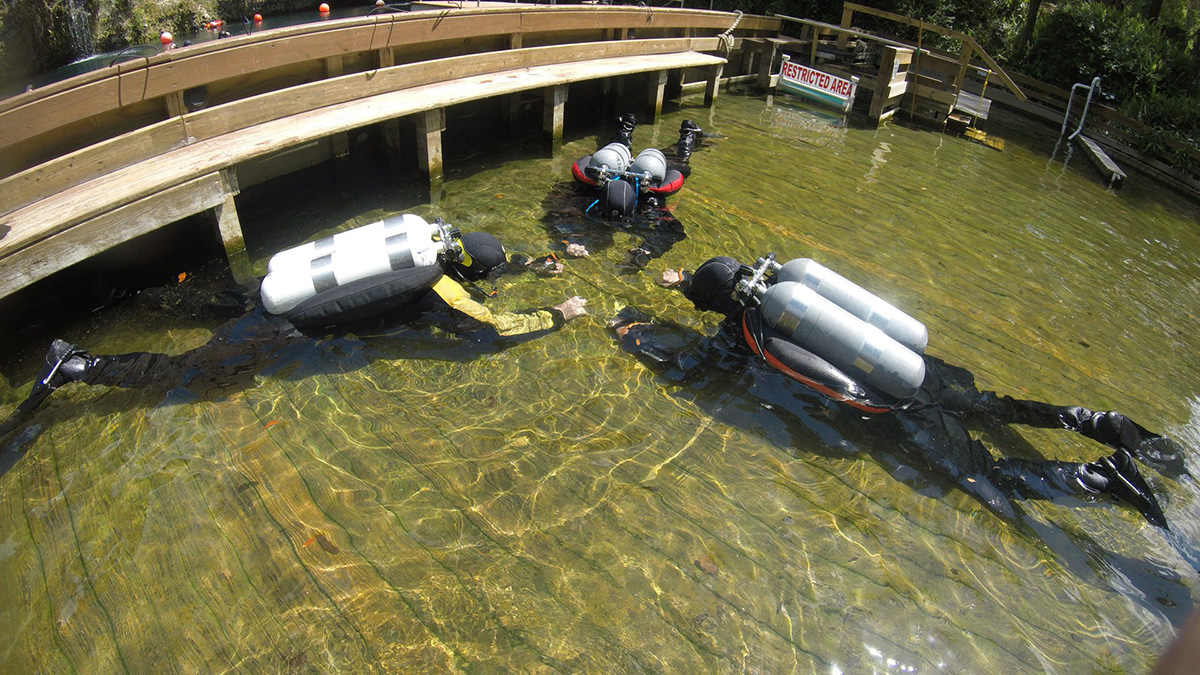
For Divers New to Twin or Double Tanks (aka “doubles”)
If you’re starting to explore the world of technical diving, you’ve probably seen divers wearing two tanks on their back with an organized, streamlined setup. Though many configurations have existed over the years, there is one simple, common method used among the most experienced and well prepared technical divers worldwide. This is known as the Hogarthian or DIR (Doing It Right) configuration. It’s not just about gear—it’s a holistic approach focused on simplicity, safety, and efficiency underwater.
Let’s break down the fundamentals of the Hogarthian doubles setup and how it differs from less thought out and purposeful diving configurations.
What Is the Hogarthian/DIR Setup?
The DIR system was developed by some of the world’s most experienced cave and technical divers. It emphasizes standardization, minimalism, and functionality—every piece of gear has a specific purpose and location, reducing failure points and making emergency procedures fast and instinctive.
At the heart of this system is the Hogarthian configuration, named after explorer Bill Hogarth Main. It’s the specific equipment arrangement used within the DIR framework, especially when diving with double tanks.
Key Components of the Hogarthian Doubles Setup
Double Tanks Manifolded Together (aka “doubles”)
In the event of a failure on one side, the diver can isolate that side and still access gas from the other.
Two tanks are connected by a manifold, allowing access to gas from both tanks via two independent first stages.


Backplate and Wing System
A rigid backplate (usually stainless steel or aluminum) provides stability and streamlines the diver’s profile.
It’s secured with a continuous piece of webbing, forming shoulder straps, a waist strap, and a crotch strap.
The harness includes five D-rings:
One on the left hip
One on each shoulder strap
One front and one rear on the crotch strap
Backup lights (if used) are held under small elastic bands on the shoulder straps.
The wing-style BC provides buoyancy only on the diver’s back—no air cells around the waist or chest, keeping the diver trim and stable in the water.
Regulator Configuration
The primary second stage is on a long hose—typically 7 feet / 84 inches long.
This hose comes from the right post first stage, runs down the diver’s right side, behind the wing, under the light canister (or waistband), across the chest, around the neck, and into the mouth.
When not in use, the second stage is clipped to the right shoulder D-ring.
In an emergency, the long hose is donated to the out-of-air diver, ensuring plenty of room to exit side-by-side in tight spaces (especially caves or wrecks).

The backup second stage is on a short hose (typically 22 inches long) and is worn on a bungee necklace just under the chin.
It connects to the left post first stage. This hose is not clipped off; it’s always ready for immediate use if the diver has to switch regs.
The power inflator hose (typically 20 inches long) for the wing comes from the right post, using a shorter hose to match the compact inflation assembly.
The SPG (submersible pressure gauge) is connected to the left post, routed straight down the diver’s left side and clipped to the left waist D-ring on a 24 or 26 inch HP hose for easy monitoring.
Dry suit inflator hose (if used) also comes from the left post.
Why Use This Setup?
Consistency Saves Lives. In a team-based diving environment (like cave or technical diving), everyone using the same setup means:
No confusion during emergencies
Immediate access to gas or gear
Predictable placement of tools and backups
Streamlined and Simple. No dangling hoses or cluttered equipment. The diver moves more efficiently through the water and has fewer snag hazards.
Redundancy and Control. Each tank and regulator is independently plumbed. With practice, a diver can isolate and manage gas loss issues calmly and effectively.

Is This Only for Cave Diving?
Not at all. While it originated in cave diving, the Hogarthian setup is now common among all forms of technical diving—wreck diving, deep diving, or even recreational diving – in fact we teach a single tank version of this equipment configuration in our Open Water Diver course! It’s ideal for any dive where reliability, team safety, and equipment redundancy are important.
Final Thoughts
The Hogarthian or DIR doubles configuration may seem rigid at first, but that’s the point: a standardized system that eliminates guesswork and keeps you safe. Whether you’re considering technical training or just curious, understanding this approach is a great step in your diving journey.
Remember, gear configuration is only part of the equation. Training, practice, and mindset matter just as much. Seek out a qualified instructor, try diving in doubles, and experience the confidence and control that the DIR/Hogarthian system offers.